
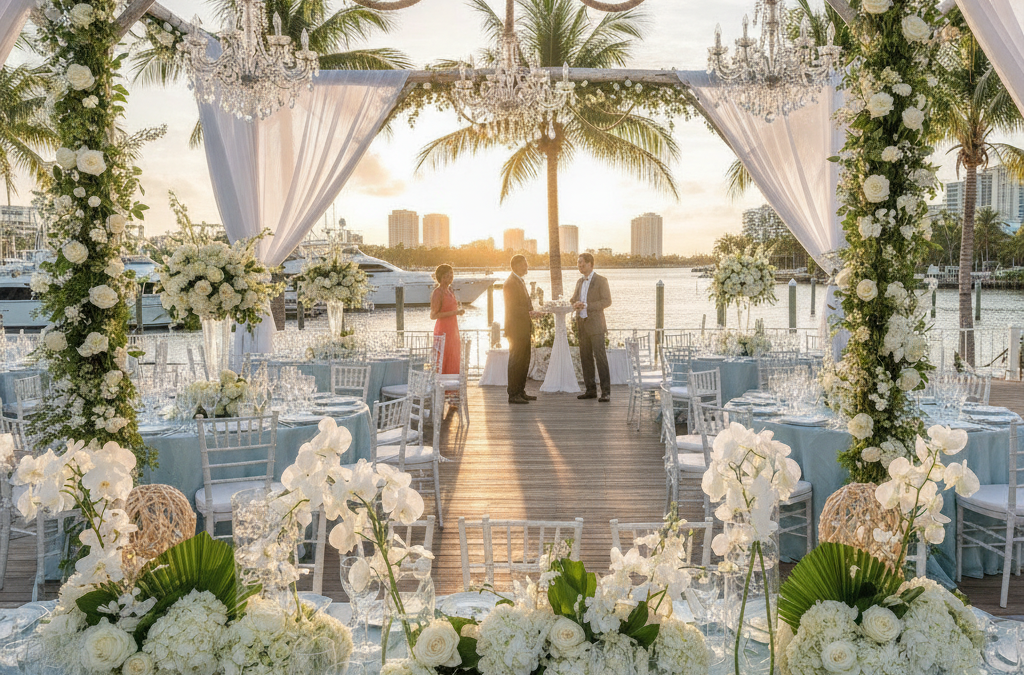
How Do You Design Florals for a Yacht Club or Marina Wedding in Fort Lauderdale?
Designing florals for a yacht club or marina wedding in Fort Lauderdale is a fundamentally different challenge from designing for a ballroom or hotel garden. You’re working with an environment that’s actively working against you — salt air that wilts delicate blooms ahead of schedule, ocean breezes that can dismantle a ceremony arch mid-vow, dock surfaces that don’t accommodate standard stands or bases, and water reflections that completely change how color reads. When it’s done well, a waterfront yacht club wedding is one of the most spectacular event backdrops in South Florida. When it’s done without that venue-specific experience, it can unravel before the first dance.
Fort Lauderdale’s marina and yacht club scene is genuinely world-class. From the Harbor Beach corridor to properties near Dania Beach and the intracoastal stretches north toward Hallandale Beach, these venues attract couples who want the drama of the water woven into every detail — including the flowers. That means your floral designer needs to understand not just aesthetics, but structural engineering, installation logistics, and the biology of blooms in a coastal microclimate.
Why Yacht Club and Marina Venues Demand a Different Design Approach
Most generic florists aren’t designed to handle the complexity of a dock or waterfront venue. The challenges are layered, and they start before a single stem is conditioned.
Salt air and humidity accelerate floral decline. South Florida’s coastal humidity is relentless, and salt air is particularly harsh on softer, higher-water-content blooms like garden roses, sweet peas, and ranunculus. A flower that would easily last four to six hours in a climate-controlled ballroom may look tired within two at a dock-level reception. Designing for a marina venue means building your palette around varieties that are proven performers in coastal conditions — think tropical anthuriums, waxy orchids, sturdy proteas, and densely petaled spray roses that hold their structure even when the air is working against them.
Wind is a structural design constraint, not just an inconvenience. On an open waterfront, especially during Fort Lauderdale’s peak fall and winter wedding season, wind off the Intracoastal or the Atlantic is a genuine design variable. Tall ceremony arches, hanging installations, and lightweight arrangements can become dangerous or visually chaotic without proper ballasting, mechanical anchoring, and design choices that account for movement. A well-designed floral arch for a marina wedding uses weighted bases, concealed anchoring hardware appropriate for dock surfaces, and structural plant material — larger-stemmed tropical leaves, woody branches, or dense foliage — that frames more delicate florals and absorbs wind load without the whole arrangement reading as messy.
Dock logistics require advance planning and the right equipment. Transporting floral arrangements onto a working dock or marina property involves challenges that simply don’t exist at a hotel venue. Cart access is limited. Surface materials — teak, composite decking, concrete — don’t work with standard floral risers. Electricity access for cooling or lighting is venue-specific. A floral designer who has only worked in traditional indoor venues will encounter all of these for the first time on your wedding day if you haven’t confirmed their experience in advance.
What to Look for in a Floral Designer for a Marina or Yacht Club Wedding
Before you commit to a floral studio for your yacht club wedding, ask directly about their experience at waterfront and dock-level venues. This isn’t a conversation most florists will bring up proactively — it’s one you need to initiate. Specifically, ask:
- Have you designed florals for an open-air marina or dock setting before, and what did the installation look like?
- How do you anchor or ballast ceremony arches and large installations at venues without interior anchor points?
- Which flowers do you recommend avoiding in coastal outdoor settings, and why?
- How do you stage and transport arrangements for a venue with limited vehicle or cart access?
- Are you familiar with the specific venue’s vendor requirements and access windows?
The answers to these questions will tell you quickly whether you’re talking to a studio that has genuinely done this work or one that is confident in a generic way that doesn’t translate to your specific setting. Fort Lauderdale’s luxury wedding floral design market is competitive, but venue-specific expertise at waterfront properties is meaningfully rarer than general wedding floristry.
Floral Design Choices That Work on the Water
The aesthetic of a yacht club or marina wedding is distinct from a garden wedding or a resort ballroom event. The best floral design for these venues tends to lean into the setting rather than fighting it — incorporating the colors, textures, and natural materials that feel native to a nautical, coastal environment while still delivering the elevated luxury that couples expect.
Palettes that read beautifully against open water and sky include deep indigos, champagne whites, warm corals, and greens ranging from tropical palm to silvery eucalyptus. Moody, saturated arrangements can photograph strikingly against a marina backdrop at golden hour. Organic, asymmetric designs often suit the energy of a waterfront setting better than tight, symmetrical arrangements that can look stiff outdoors.
For ceremony structures specifically, consider lower-profile designs that don’t fight the wind — a wide, horizontal floral installation along a dock railing, for example, can be as visually dramatic as a tall arch while presenting a fraction of the wind resistance. Custom floral installations designed for specific venue constraints tend to be the most successful at marina properties, because they’re built around the space rather than adapted from a standard product.
The Logistics Layer Most Florists Overlook
Beyond the florals themselves, a marina wedding requires detailed logistics coordination that overlaps with event planning. Load-in windows at yacht clubs near Las Olas or the Harbor Beach area are often tightly controlled. Some properties require vendors to move equipment via specific access routes that avoid guest areas or active boat slips. Electrical power for refrigerated transport or floral care may be limited or require advance coordination with the venue’s facilities team.
For couples planning their wedding from out of state — and Fort Lauderdale does attract a significant number of destination couples drawn to the South Florida waterfront — having a floral partner who has already navigated these venue-specific logistics is essential. You won’t be on-site to troubleshoot a setup problem on the morning of your ceremony. Your designer needs to own that entirely.
Broward County yacht clubs and marina properties also tend to have stricter vendor approval and insurance requirements than many residential or garden venues. A floral studio that regularly works with these properties will already be on approved vendor lists or will know exactly what documentation is needed to get there.
Frequently Asked Questions: Yacht Club and Marina Wedding Florals in Fort Lauderdale
Which flowers hold up best at an open-air marina venue in South Florida?
Tropical varieties like anthuriums, birds of paradise, and orchids are well-suited to coastal humidity. Sturdy garden varieties like spray roses, proteas, lisianthus, and succulents also perform reliably. Avoid overly delicate blooms — garden roses used in a marina setting should be sourced at peak condition and kept in climate-controlled storage until setup.
How far in advance should I book a floral designer for a yacht club wedding?
For Fort Lauderdale yacht club and marina weddings during peak season — roughly October through April — you should plan to secure your floral designer nine to twelve months in advance. These venues book quickly, and designers with genuine waterfront experience are in high demand during the compressed peak window.
Can large floral arches and installations be safely set up on a dock?
Yes, but only with appropriate structural planning. A qualified floral designer will use weighted bases, non-damaging anchoring solutions appropriate for the dock surface, and structural plant material that helps manage wind load. This is not a standard setup — it requires advance site assessment and specific equipment.
Do yacht clubs near Fort Lauderdale require vendors to be pre-approved or insured?
Most upscale yacht club and marina properties in Broward County do require vendors to carry general liability insurance and may require advance approval or a certificate of insurance. Always confirm vendor requirements directly with your venue and ensure your floral designer can meet them.
What areas around Fort Lauderdale have strong yacht club and marina wedding venue options?
Fort Lauderdale’s waterfront offers exceptional options, particularly in the Harbor Beach, Las Olas, and Intracoastal neighborhoods. Properties near Dania Beach, Hallandale Beach, and Hollywood also offer notable marina and waterfront event venues within easy range of Broward County’s floral and event vendor community.
Ready to Design Your Waterfront Wedding Florals?
A yacht club or marina wedding deserves floral design that was built for that setting from the ground up — not adapted from an indoor template the morning of your event. At Bayfront Floral & Event Design, we design specifically for Fort Lauderdale’s waterfront venues, with real experience in the structural, logistical, and aesthetic challenges that make these events extraordinary when they’re executed well.
Whether you’re envisioning a dramatic ceremony arch overlooking the Intracoastal, a lush reception tablescape that mirrors the colors of the water at dusk, or a full custom floral concept built around your venue and vision, we’d love to hear about your wedding. Reach out to schedule a consultation — and let’s start designing something that belongs exactly where you’re getting married.