
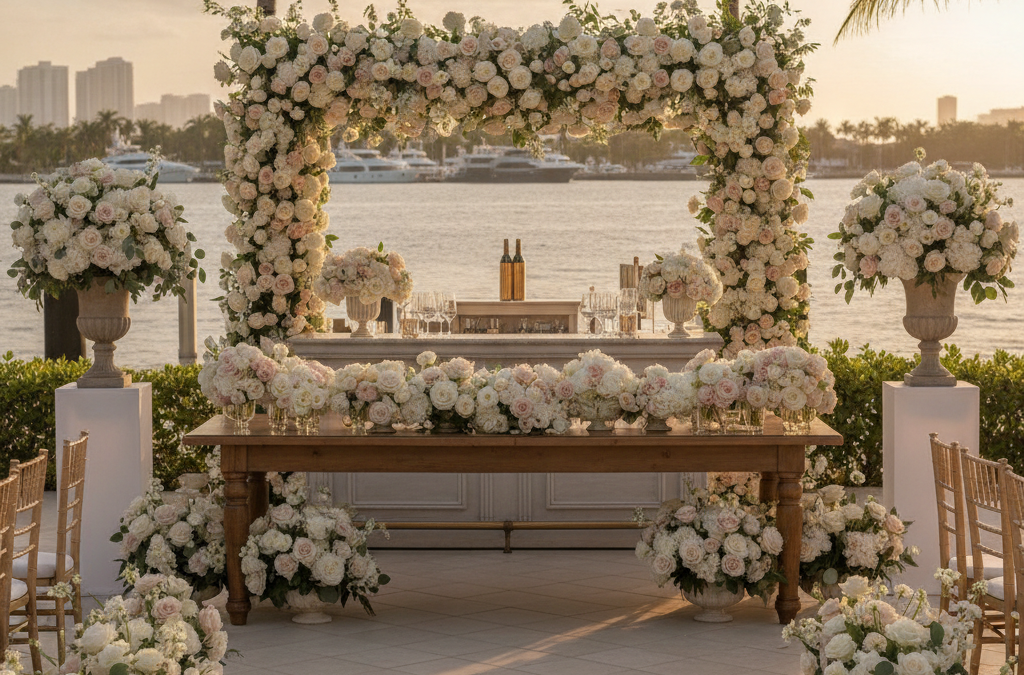
How Do You Design Florals for a Fort Lauderdale Wedding That Transitions Seamlessly From Ceremony to Reception — Without Starting Over?
The answer is intentional design from the very beginning. In Fort Lauderdale, where many wedding venues host both the ceremony and reception within steps of each other — a waterfront terrace flowing into a ballroom, an outdoor altar facing the Intracoastal leading into an indoor dinner — the opportunity to move floral pieces strategically between spaces is one of the most underutilized tools in wedding design. Done well, it creates a cohesive visual story across your entire event. Done poorly — or not planned at all — you end up either overspending to fill the reception or leaving it feeling like a different wedding entirely.
This is one of the topics that most local floral studios simply don’t address in any practical depth. You’ll find plenty of content about ceremony arches and reception centerpieces as isolated elements, but very little about how they can — and should — relate to each other as part of a single, flowing design plan. That gap matters, because the transition between spaces is often where the design energy either holds or falls apart.
Why the Ceremony-to-Reception Transition Is a Design Problem Worth Solving
Most couples think about their ceremony florals and their reception florals as two separate budgets and two separate visions. That instinct is understandable — they’re different spaces, different moods, different moments. But separating them entirely means missed opportunity and, more often than not, unnecessary cost.
The reality of South Florida waterfront weddings is that your guests often experience both spaces in the same evening, sometimes within the same hour. When the design language doesn’t carry through — when the lush tropical altar greenery has no visual echo in the reception room — guests sense the discontinuity even if they can’t name it. When it does carry through, the whole event feels considered, elevated, and complete.
There’s also a straightforward financial argument. Flowers that are designed to move — altar arrangements repurposed as bar accents, ceremony pedestals repositioned as reception focal points, aisle markers reused as buffet decor — stretch your floral investment significantly. At a well-designed Fort Lauderdale wedding, a skilled floral team can often reuse 30 to 50 percent of ceremony florals in the reception without any visible degradation in quality or freshness, particularly during the cooler months from October through April when South Florida’s outdoor conditions are more forgiving.
What “Transition Design” Actually Means in Practice
Designing for transition doesn’t mean designing everything to look identical — it means building a visual thread that connects the two spaces deliberately. Here’s how that works across the specific elements that are most commonly moved:
Ceremony Altar and Arch Florals
A large ceremony arch is often the single most expensive floral piece at a wedding. After the ceremony ends, it typically sits unused — sometimes dismantled on-site while guests are at cocktail hour. But a well-engineered arch can be partially or fully disassembled and relocated to frame a sweetheart table backdrop, a lounge seating area, or a grand entrance to the reception room. This requires advance planning at the design stage: the structural armature needs to accommodate breakdown and rebuild, and the flowers need to be secured in a way that survives transport without looking handled.
At Bayfront Floral & Event Design, installation pieces are engineered specifically with this kind of transition in mind when it’s part of the plan — which means the florals arrive at the reception in the same condition they were in at the altar.
Ceremony Pedestals and Column Arrangements
Flanking pedestal arrangements are among the easiest pieces to relocate. During cocktail hour, your floral team moves them from the ceremony aisle ends to the reception bar, entry corridor, or lounge vignette. Because they’re self-contained, they require minimal setup time and no re-floraling. Guests arriving to the reception see familiar floral shapes in new contexts — the design feels cohesive without feeling repetitive.
Aisle Markers
Hanging aisle lanterns, low bud vase clusters, or tied aisle arrangements can be collected and grouped onto reception surfaces — a buffet table, a dessert display, a cocktail table cluster — as filler arrangements that add texture without requiring a separate line item. This is particularly effective for Las Olas-area garden and estate venues where the indoor and outdoor spaces flow naturally into each other.
What Your Floral Designer Needs to Make This Work
A transition plan only works if it’s built into the original design brief — not added as an afterthought the week before the wedding. If you’re asking about this for the first time during your final walkthrough, you’ve likely already locked in a design that wasn’t engineered for movement.
When you’re exploring wedding floral design options, here are the questions worth raising early in the process:
- Which ceremony pieces are designed to be relocated, and which aren’t? Not everything moves well — some installation elements are too fragile, too structurally dependent on the ceremony space, or too time-intensive to rebuild. Know which is which before you build a budget assumption around them.
- How much time does your team have between ceremony and reception setup? At most Fort Lauderdale venues, the window is 45 to 90 minutes — typically the cocktail hour. A skilled floral team can move, reset, and style a significant number of pieces in that time, but only if the logistics have been pre-mapped.
- Does the venue allow vendor access to both spaces simultaneously? Some resort properties and hotel ballrooms have staging restrictions that limit when and how vendors can move through the space. This is a venue conversation your floral designer should be part of, not just your planner.
- Will the flowers hold? South Florida’s heat and humidity are significant factors, particularly for outdoor ceremonies in September and October. Your designer should be selecting varieties and using conditioning methods that account for the transition — flowers that are already stressed from two hours in open air won’t recover for a three-hour reception.
The Venues Where This Strategy Works Best in Fort Lauderdale and the Surrounding Area
Transition design is most effective at venues where the ceremony and reception spaces are physically close and share similar aesthetic character. In the Fort Lauderdale area, that includes waterfront resort properties along A1A, yacht club venues in Pompano Beach and Hollywood where the dock-side ceremony flows into an indoor or tented reception, and estate-style venues in Dania Beach and Boca Raton where indoor-outdoor transitions are built into the architecture.
It’s less straightforward at venues where ceremony and reception are in completely different buildings or where the aesthetic contrast between the two spaces is dramatic. In those cases, a shared color palette and complementary floral vocabulary — rather than physically moving pieces — becomes the design tool that creates cohesion.
Frequently Asked Questions
How much can I realistically save by repurposing ceremony florals at my reception?
It varies depending on your venue layout and design complexity, but couples who plan for transition from the beginning often find they can reduce their total floral spend by 15 to 25 percent compared to designing ceremony and reception florals as two completely independent events. The key word is plan — last-minute repurposing rarely delivers the same results.
Will guests notice that the florals were moved from the ceremony?
When it’s done well, no — and that’s the goal. The arrangements should feel intentionally placed in their reception context, not relocated out of necessity. Skilled floral designers style relocated pieces to suit the new space, not just set them down where they fit.
Does this approach work for beach or outdoor ceremonies in Fort Lauderdale?
Yes, but with caveats. Flowers used for outdoor ceremonies in South Florida’s warmer months need to be conditioned for heat and salt air, and your designer should factor that into variety selection. Pieces that have been in direct sun for more than an hour may not photograph as crisply in the reception, depending on the bloom. Your floral team should be transparent about which pieces are good candidates for the transition and which should be replaced.
Can my floral designer handle the transition logistics, or do I need a separate coordinator for that?
A full-service floral and event design studio handles transition logistics as part of the day-of execution. This is one of the meaningful differences between working with a dedicated event floral designer and ordering arrangements from a retail flower shop — the studio has a crew that moves and resets pieces during cocktail hour as part of the service.
How far in advance should I tell my florist I want to repurpose ceremony pieces at the reception?
Ideally, at your initial design consultation — or at least by the time the final design proposal is drafted. Building a transition plan after the floral design is finalized often means reworking structural decisions that were already locked in. The earlier you raise it, the more options you have.
Ready to Design a Wedding Where Every Piece Has a Purpose?
At Bayfront Floral & Event Design, we approach every Fort Lauderdale wedding as a complete visual experience — not a checklist of separate floral line items. That means thinking about how your ceremony florals connect to your reception design from the very first conversation, and building a plan that makes the most of every arrangement, installation, and stem.
If you’re planning a waterfront wedding, a resort celebration, or any upscale event across Broward County and the surrounding area, we’d love to hear about your vision. Reach out to schedule a consultation and let’s start designing something that holds together beautifully from the first petal to the last dance.