
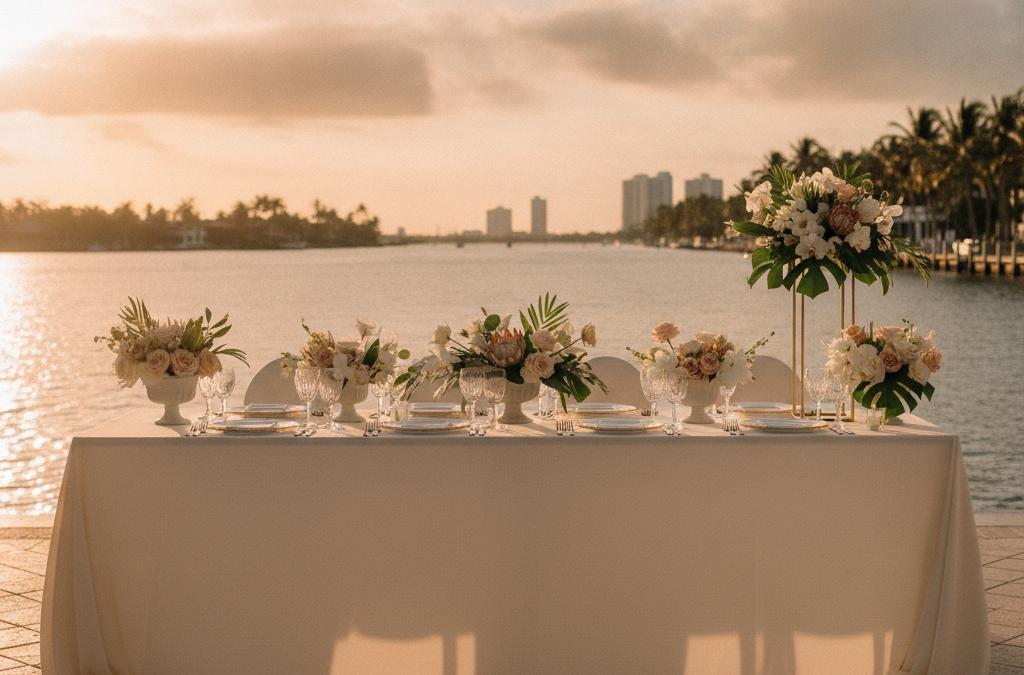
How Do You Style Floral Centerpieces for a South Florida Waterfront Reception That Actually Photographs Well?
At a waterfront reception in Fort Lauderdale, your centerpieces are competing with one of the most dramatic backdrops on earth — open water, shifting light off the Intracoastal, and a horizon that doesn’t stop for anyone. The answer to what works isn’t a single formula. It’s a set of deliberate design decisions made with your venue, your photographer’s perspective, and South Florida’s climate all factored in before a single stem is sourced. The couples and planners who end up with reception photos they genuinely love are the ones who thought through centerpiece design as a visual and environmental system — not just a table decoration.
Why Waterfront Venues Change Everything About Centerpiece Design
Most generic centerpiece advice — the kind you’d find on a national wedding blog or pull from a Pinterest board — was not written with an outdoor waterfront reception in mind. What photographs beautifully in a climate-controlled ballroom in the Midwest may fall completely flat at a property on Fort Lauderdale’s Harbor Beach waterfront or along the canals near Coral Ridge. The light is different. The wind is real. The humidity is constant. And the background you’re designing against is vast.
When a reception is set along the water — whether at a yacht club, a marina-adjacent property, or one of the open-air resort terraces throughout Broward County — the visual competition is enormous. A centerpiece that might read as “lush and full” in an enclosed venue can look small and visually lost against an expansive waterfront backdrop. Scale matters here in a way it simply doesn’t indoors.
This is a nuance that tends to be either skipped entirely or addressed only in vague terms on most local florist websites. The practical reality is that designing for a waterfront reception in Fort Lauderdale requires a working knowledge of how natural light behaves in South Florida at golden hour, how wind affects floral structures at an open-air venue, and how the background behind your guests’ tables will read in wide-angle reception photos.
The Photography Question Most Couples Don’t Think to Ask
Here’s what your wedding photographer already knows and rarely gets to say out loud: the centerpiece heights you choose will determine what they can and cannot capture at your reception. A room full of uniformly low centerpieces, while intimate and conversation-friendly, can photograph as flat and undifferentiated from above — particularly at an outdoor venue where there’s no ceiling to frame the image. A room full of tall, statement centerpieces can look spectacular in wide shots but create visual chaos in tighter guest portraits if the scale is not carefully calibrated.
The most photogenic waterfront receptions tend to mix intentionally. A design strategy that alternates tall arrangements — perhaps elongated orchid columns, sculptural protea clusters on elevated vessels, or dramatic tropical canopy pieces — with lower, more organic garden-style clusters gives photographers something to work with at every angle. It also gives guests the experience of moving through a space that feels designed rather than decorated.
If you’re working with a full ceremony and reception floral plan, your designer should be having this conversation with your photographer directly or at minimum asking you what shooting style your photographer uses. A designer who treats centerpieces as an isolated line item rather than a component of the overall visual experience is leaving your photos to chance.
Height, Scale, and the Waterfront Backdrop
At venues along the Las Olas waterfront, in Hollywood, or at marina properties near Dania Beach and Hallandale Beach, you’re often designing against a view that extends hundreds of feet behind your guests. In that context, here is what tends to work:
- Elevated arrangements on slender pedestals or compotes — These draw the eye upward and create vertical interest without blocking views or sightlines across the table. Thin-necked vessels in antique brass, frosted glass, or matte ceramic complement waterfront environments without competing with them.
- Asymmetrical, naturalistic compositions — Tight, symmetrical dome arrangements can read as stiff and overly formal against an organic waterscape. Loose, cascading designs with movement — garden roses, trailing vines, open-faced blooms — feel native to the environment and photograph with more dimension.
- Color palettes that contrast or harmonize intentionally with the water — Dusty blues and silvers disappear against an Intracoastal backdrop. Deep terracotta, blush, ivory, and warm coral tend to read clearly and photographically against blue-grey water and the golden South Florida sky at dusk.
- Candle integration — At waterfront venues where the light shifts dramatically from sunset through dinner, taper candles and low votives extend the visual life of your centerpieces into the evening hours when much of your reception photography will happen.
Humidity, Wind, and South Florida’s Reality Check
South Florida’s climate — high humidity, salt air near the water, afternoon heat even in peak wedding season — imposes real constraints on what will look the way it’s supposed to look by the time your reception reaches hour three. Delicate flowers with thin petals, such as anemones or sweet peas, will begin to show stress. Heavy-headed blooms placed in floral foam that’s been sitting in humidity all afternoon will shift and droop.
A designer who knows this market sources accordingly. For open-air waterfront receptions in Broward County, the most reliable performers include garden roses, orchids (particularly Phalaenopsis and Dendrobium varieties), anthuriums, tropical foliage like monstera and philodendron, protea, and ranunculus in cooler months. The key is building your palette around flowers that maintain their structure, rather than supplementing durable florals with fragile accent flowers that will show wear.
Mechanics also matter. Floral foam mechanics must be properly hydrated and staged in cool conditions right up until setup. Water-tube hydration is essential for taller arrangements in open-air conditions. Your designer should have a staging and setup plan that accounts for South Florida’s heat — not just a beautiful concept sketch.
What a Thoughtful Centerpiece Consultation Should Cover
When you sit down with a floral designer for your reception centerpiece consultation, you should be talking about more than bloom preferences and color swatches. A consultation worth your time will cover:
- The specific venue space — its orientation, the direction of the water view, and the ambient lighting conditions at the time of your reception
- Table count, table shape, and the mix of seating configurations (rounds, long farm tables, and cocktail tables all require different design logic)
- Your photographer’s style — editorial and documentary photographers often have very different needs from centerpiece scale
- How the centerpiece design integrates with your larger floral installation plan, including any arches, hanging pieces, or bar florals
- Logistics: when arrangements will be built, how they’ll be transported to the venue, and whether the designer or their team is handling setup and breakdown
Destination couples planning from out of state — a significant portion of the luxury wedding market at waterfront properties near Fort Lauderdale — should pay particular attention to that last point. A designer who handles their own logistics, including transport to yacht club or marina venues where loading access is restricted, is a fundamentally different partner than one who expects a coordinator to manage day-of placement.
Frequently Asked Questions
How tall should centerpieces be for an outdoor waterfront reception in Fort Lauderdale?
There’s no single correct height, but the most effective approach at an open-air waterfront venue is to mix scales intentionally. Tall arrangements — typically 28 to 36 inches at the crown — read well in wide reception photography and create vertical drama against an expansive backdrop. These work best when alternated with lower, more organic designs at neighboring tables. Your designer should assess the specific venue, table dimensions, and photography style before making a recommendation.
What flowers hold up best in Fort Lauderdale’s humidity for an outdoor reception?
Garden roses, orchids, anthuriums, tropical foliage, protea, and ranunculus are among the most reliable choices for open-air receptions in South Florida’s climate. Your designer should build your centerpiece palette around structurally durable blooms and handle hydration and staging with the local environment in mind. Fragile, thin-petaled flowers may not maintain their appearance through a full evening reception in humid outdoor conditions.
Should my centerpiece colors complement or contrast the water view at a waterfront venue?
This depends on your overall palette and the time of your reception. Warm tones — blush, terracotta, ivory, coral, and deep burgundy — read clearly and beautifully against blue-grey South Florida water, especially at golden hour. Cooler palettes like dusty blue or silver can blend into the backdrop. Your designer should view photos of your venue at the time your reception will be held before finalizing a color direction.
Do I need different centerpieces for cocktail hour and dinner at a waterfront venue?
Cocktail hour florals and dinner centerpieces serve different functions and are usually designed differently. Cocktail tables are smaller, often standing-height, and call for compact, eye-level arrangements that don’t impede conversation. Reception dinner tables require more considered scale, volume, and integration with candles and linens. A cohesive event design treats these as a connected visual story rather than two separate orders.
How early should I finalize my centerpiece design for a Fort Lauderdale wedding?
For peak season weddings — generally October through May at South Florida resort and waterfront venues — your centerpiece design should be finalized at least three to four months out. This gives your designer time to confirm specialty bloom sourcing, secure the vessels and structures needed for custom arrangements, and coordinate logistics with your venue and other vendors. Last-minute design changes can limit what’s achievable, particularly for high-volume or statement-scale centerpieces.
Design Your Reception Tables With the Whole Picture in Mind
Your centerpieces are not individual pieces — they’re part of a designed environment, and at a waterfront reception in Fort Lauderdale, that environment includes one of the most beautiful natural settings in the country. Getting those tables right means thinking about light, scale, climate, photography, and logistics as a unified design problem, not a checklist of bloom preferences.
At Bayfront Floral & Event Design, we work with couples, wedding planners, and venue coordinators across Fort Lauderdale, the Las Olas waterfront, Harbor Beach, Hollywood, Hallandale Beach, Dania Beach, and beyond to build reception designs that are as thoughtful as they are beautiful. Every centerpiece we design is built with your specific venue, season, and vision in mind — not pulled from a catalog.
If you’re ready to start designing your reception tables, we’d love to hear about your venue and vision. Reach out to schedule a consultation and let’s build something worth photographing.