
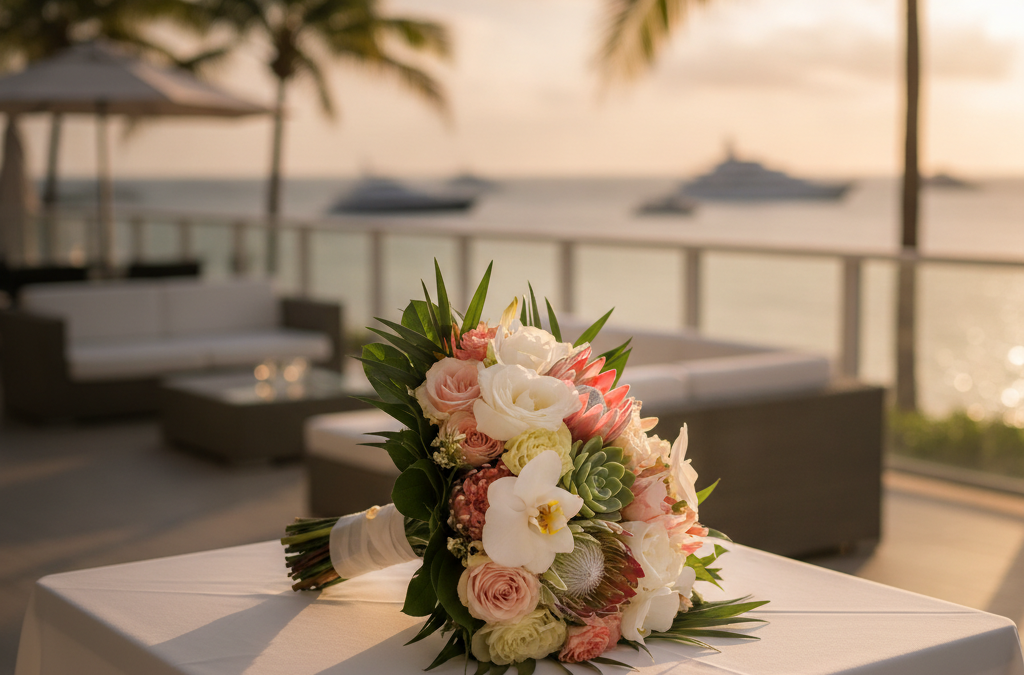
How Do You Choose the Right Bridal Bouquet for a Fort Lauderdale Wedding — and Make Sure It Photographs Beautifully in Every Light?
Your bridal bouquet is the one floral element you’ll hold from the moment you step out of the car to the last dance of the night. It appears in hundreds of photographs, travels through ceremony, cocktail hour, and reception, and needs to look as intentional in an intimate close-up as it does against a sweeping waterfront backdrop. For brides planning weddings in Fort Lauderdale — whether at a Harbor Beach estate, a Las Olas private club, or an open-air resort along the Intracoastal — choosing the right bouquet isn’t just about picking beautiful flowers. It’s about designing something that performs beautifully in South Florida’s unique conditions and photographs with depth, texture, and dimension no matter the light.
Why Bouquet Design for South Florida Weddings Is a Conversation Worth Having Early
One gap that surprises many brides is how rarely floral studios — even local ones — walk you through the photography implications of your bouquet choices. Blooms, stem lengths, ribbon treatments, and color saturation all behave differently in bright Florida midday sun than they do under the warm amber glow of an indoor reception. A lush all-white bouquet that looks ethereal indoors can wash out entirely in a ceremony shot on a white sand beach. Deep burgundy ranunculus that read as rich jewel tones in edited images may look nearly black in certain natural light. These are the details that separate a designer who thinks about your full wedding day from one who simply sources and arranges.
At Bayfront Floral & Event Design, bouquet consultations cover your venue, your photographer’s style, the time of your ceremony, and the color palette of your surroundings — not just the flowers you happen to love on a Pinterest board.
Understanding How Fort Lauderdale’s Climate Affects Bouquet Performance
Broward County’s humidity and heat are real factors that affect which flowers hold gracefully through a six-to-eight-hour event — and which ones wilt before the first dance. This matters especially for outdoor ceremonies, waterfront cocktail hours, and beach portrait sessions where your bouquet is in hand for extended periods.
Flowers that tend to perform well in South Florida heat include:
- Garden roses and spray roses — especially in tighter, denser blooms that hold their shape well
- Orchids — particularly phalaenopsis and dendrobium, which are naturally adapted to tropical humidity
- Anthuriums — bold, architectural, and genuinely heat-resilient
- Protea and tropical foliage — stunning for coastal and modern tropical aesthetics and nearly impervious to humidity
- Ranunculus and peonies — these work beautifully in the fall-through-spring peak season when temperatures are more moderate
Flowers that require more careful handling in summer months include hydrangeas, sweet peas, and some open garden roses — not impossible to use, but ones that need proper conditioning, refrigeration until the last possible moment, and strategic placement in the bouquet structure to stay fresh through a full event day.
A skilled bouquet designer knows this before you ask. They plan around it without sacrificing the aesthetic you want.
What Actually Makes a Bouquet Photograph Well — and What No One Tells You
Most articles about bridal bouquets tell you to choose flowers you love and pick a shape that suits your dress. That’s a starting point, not a design strategy. Here’s what experienced floral designers actually consider for bouquets that photograph beautifully:
Depth and Texture Over Flat Color
Bouquets that read as one-dimensional in photographs are usually lacking textural contrast — blooms at all one height, all one scale, with no variation in petal density or shape. A well-built bouquet layers large focal blooms (garden roses, peonies, protea) with mid-size supporting flowers (ranunculus, spray roses, lisianthus) and delicate filler elements (astilbe, jasmine vine, eucalyptus, dried grasses) so that the camera has something to move through. This layered quality creates dimension in flat photographs and adds organic movement in film.
Color Contrast Relative to Your Dress and Setting
If you’re wearing an ivory gown and marrying at a white-tent reception in Boca Raton, an all-cream bouquet can be visually lost in your bridal portraits. Conversely, a bride marrying against the rich blue-green of the Intracoastal at golden hour benefits enormously from warm corals, blush tones, or dusty mauve that echo the light rather than compete with the water. Your florist should be asking where your portraits will happen and at what time of day — because that context shapes every color decision in your bouquet.
Stem and Ribbon Presentation
The bottom third of your bouquet appears in more photographs than most brides anticipate — especially during vows, ring exchanges, and posed portrait sessions. A beautifully wrapped stem, finished with silk ribbon, a satin knot, or a trailing ribbon detail, is part of the composition. This is a detail worth discussing intentionally, not leaving to default.
Matching Bouquet Scale to Your Dress and Venue
Scale is one of the most overlooked elements in bouquet design. A small, tight posy can look elegant carried by a petite bride in a fitted gown at an intimate Las Olas dinner reception — and completely underwhelming when that same bride walks down a grand aisle at a Broward County resort ballroom with forty rows of guests. Conversely, an oversized cascading bouquet can overpower a bride in a minimalist sheath gown, drawing the eye to the flowers rather than to her.
The right scale conversation involves your dress silhouette, your height, the width of your aisle, and the formality of your venue. An experienced designer walks through all of this with you during your consultation — not to override your preferences, but to ensure what you love translates to what you see in your photographs.
Explore the full range of bridal and bridal party bouquet design services offered by Bayfront Floral & Event Design to get a sense of the approach behind each bouquet we build.
Coordinating Your Bouquet With the Full Wedding Floral Design
A bouquet that exists in isolation from the rest of your wedding florals creates a visual disconnect that photographs notice even when guests don’t. Your bridal bouquet should feel like it belongs to the same world as your ceremony arch, your reception centerpieces, and your bridal party arrangements — sharing color story, textural language, and design intention even when each piece has its own character.
This is the difference between hiring a florist to fill an order and working with a floral designer who builds a cohesive visual narrative across your entire event. If you’re planning a waterfront wedding in Fort Lauderdale or along the Harbor Beach coastline, that narrative should also respond to the setting — the quality of the light, the colors of the water and sky, and the mood of the venue architecture.
See how our full approach to wedding floral design brings every element — from bouquet to installation — into one unified vision.
Frequently Asked Questions About Bridal Bouquets for Fort Lauderdale Weddings
When should I start the bridal bouquet conversation with my floral designer?
Ideally, your bouquet design is discussed at your initial consultation — not as a last-minute add-on. This allows your designer to source blooms that are seasonally available, coordinate colors across your full floral palette, and account for any specialty flowers that require advance ordering or importing.
Can I use flowers I love even if they’re not traditionally heat-tolerant?
Often, yes — with the right preparation and a thoughtful designer who knows how to condition and protect more delicate blooms. The key is honesty: your florist should tell you if a specific flower carries a meaningful risk rather than simply agreeing to use it and hoping for the best on your wedding day.
How many bouquets do I need for my bridal party, and how should they relate to mine?
Most brides carry a slightly larger, more elaborate bouquet than their bridesmaids — the bridal bouquet serves as a focal point while bridesmaids’ arrangements support the overall palette without competing. The number you need depends on your party size, but even a small bridal party benefits from thoughtfully coordinated arrangements rather than scaled-down replicas of your bouquet.
Does the shape of the bouquet really matter for photographs?
Yes, meaningfully so. Round, hand-tied bouquets photograph cleanly from the front but can appear flat in profile shots. Loose, asymmetric garden-style bouquets add movement and organic energy to portrait sessions. Cascading bouquets create a dramatic vertical line that elongates your silhouette. Each shape tells a slightly different visual story, and your photographer will likely have preferences based on how they shoot.
How far in advance do you finalize the bouquet design?
The overall design concept is confirmed months in advance, but specific bloom selections are often confirmed two to three weeks before your wedding based on seasonal availability and what our growers have at peak quality. This flexibility is actually an advantage — it ensures your bouquet is built with the freshest possible flowers rather than sourced and locked in so far ahead that quality becomes unpredictable.
Ready to Design a Bouquet That’s Unmistakably Yours?
Your bridal bouquet should be one of the most considered elements of your entire wedding design — not the last thing on the checklist. At Bayfront Floral & Event Design, every bouquet we build begins with a real conversation about your venue, your photographer, your gown, and the full story you want your wedding to tell. We work with brides across Fort Lauderdale, Broward County, and beyond — including destination couples planning from out of state who need a trusted local partner to translate a vision into something real.
Schedule your consultation today and let’s start designing a bouquet — and a wedding floral experience — that photographs as beautifully as it feels to carry.